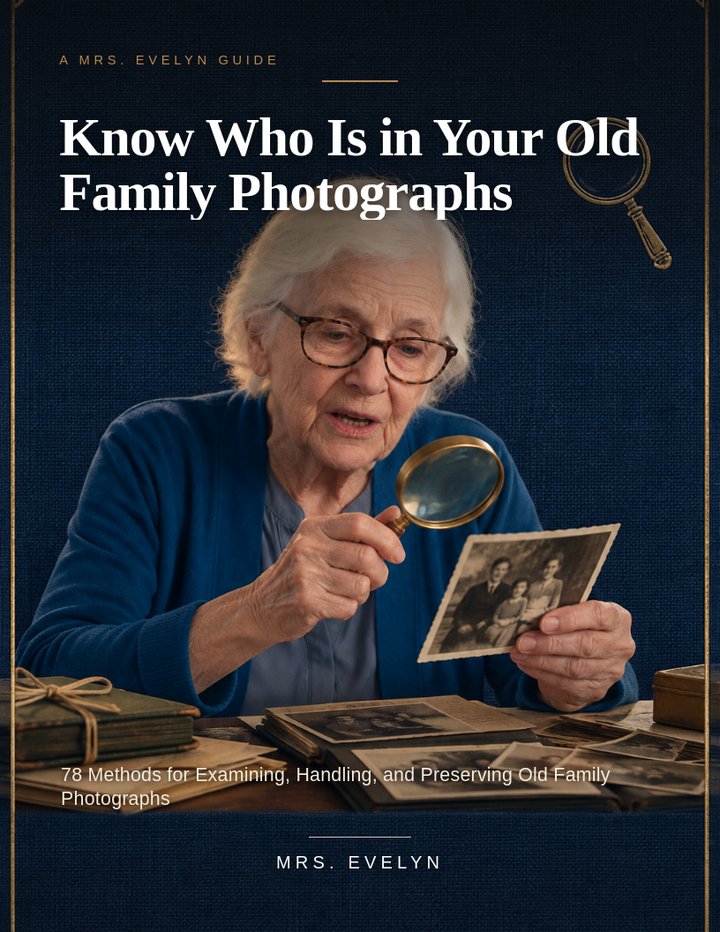
You have photographs with faces, places, and stories that are not yet certain. This book gives you 78 methods for examining clues, recording evidence, and handling originals with care.
Plus 3 separate bonus books.Including Name the People in the Picture.
One digital bundle. PDF to read or print, plus EPUB for e-readers.
193Pagesin the main book
11Chaptersread in any order
3Bonus booksall included
Instant downloadPDF + EPUB for any device or e-reader
30daysRead-It-First Guarantee30 days, every dollar back
01 · How it helps
For the moments when a photograph leaves you unsure
You do not have to settle every question at once. Choose the method that fits the photograph and the clue you have in hand.
1Dating and placing a photo
How can I tell when this old studio portrait was taken?
✓Trace Photographer Imprints Through City Directories and Newspaper Ads: turn the card over and check the photographer's name and street address against dated records. Chapter 02
Is this really Mom's childhood home, or just a lookalike?
✓Compare Porches, Fences, Rooms, and Outbuildings With Known Family Homes: trust the order of doors, windows, steps and roof edges over wallpaper or furniture. Chapter 03
2Putting names to faces
How do I keep names straight in a big family group photo?
✓Number Every Person Left to Right and Back Row to Front: number faces on a copy so no name slides to the next face. Chapter 04
She looks just like Grandma. Can I write down her name?
✓Mark Each Identification as Possible, Probable, or Confirmed: label every proposed name. Confirmed needs an explicit name and an independent source, never looks alone. Chapter 01
3Asking the relatives
My aunt doesn't recognize the faces. What else can I try?
✓Use a Name, Place, Recipe, Tool, Song, or Household Object as the Memory Trigger: ask about a concrete detail, like a worn mixing bowl. Chapter 09
My cousin has the same photo. Is it worth seeing hers?
✓Recover Missing Names From Duplicate Prints, Crops, and Copies Held by Other Relatives: check its front, back and enclosure for names your copy lacks. Chapter 04
4Labeling and storing photos
Is it safe to write names on the back of photos?
✓Keep Labels Reversible and Choose a Photo-Safe Enclosure for Each Original: write on replaceable housing or an outside label, never on the photo. Chapter 11
Do I need special archival boxes for my old photos?
✓Rehouse Photographs in Photo-Safe Sleeves and Boxes, Then Choose a Cool, Dry Interior Location: for stable photos, improve the room before buying elaborate containers. Chapter 11
02 · What’s inside
11 chapters for careful photo work
Each chapter gives you separate methods to choose from, along with a small task for tomorrow. You can begin with the question in front of you and keep a clear record as you go.
01
Open an Unknown-Photo Case
Chapter 1
Assign Every Photograph a Unique Case Number
Photograph the Front, Back, Sleeve, and Album Page Before Separation
Complete a One-Photo Name, Relationship, Date, Place, and Occasion Sheet
Transcribe Every Caption, Stamp, Studio Mark, and Pencil Note Verbatim
Separate Known Facts, Remembered Claims, Inferences, and Open Questions
Record the Source and Date Behind Every Proposed Name
Build a Candidate List From Family Branch, Place, Date, and Occasion
Mark Each Identification as Possible, Probable, or Confirmed
02
Find When the Photograph Was Taken
Chapter 2
Classify Daguerreotype, Ambrotype, Tintype, Cabinet Card, Postcard, or Snapshot Format
Date Photographer Imprints With City Directories and Newspaper Ads
Date Card Mounts, Borders, Corners, and Print Finishes
Bracket the Date With Clothing Silhouettes and Garment Details
Bracket the Date With Hairstyles, Facial Hair, Hats, and Eyewear
Date Uniforms, Badges, School Dress, and Work Clothes Against Local References
Test the Estimated Date Against Life Dates and Apparent Age
03
Find the Place and Occasion
Chapter 3
Use Studio Addresses, Postmarks, and Envelope Returns to Name the Town
Enlarge Storefront Names, Street Signs, House Numbers, and License Plates
Match Buildings and Streetscapes to Local Archive Photographs
Compare Porches, Fences, Rooms, and Outbuildings With Known Family Homes
Use Historical Maps and City Directories to Test an Address
Identify the Occasion From Decorations, Programs, Ribbons, Bouquets, and Table Settings
Read Album Sequence and Neighboring Photos as Trip, Visit, or Event Context
04
Name the People in Group Photographs
Chapter 4
Number Every Person Left to Right and Back Row to Front
Work Outward From One Confirmed Person in the Group
Assign Each Person an Age Band and Generation Before Naming Them
Find Repeated Family Units Across Several Group Photographs
Match Wedding, Reunion, School, Church, or Workplace Roles to Positions and Clothing
Compare the Group With a Census Household, Class List, Church Directory, or Reunion Roster
Recover Missing Names From Duplicate Prints, Crops, and Copies Held by Other Relatives
05
Build and Test the Candidate List
Chapter 5
Start With the Album Owner's Relatives, Neighbors, and Regular Visitors
Build Census-Household Candidate Sets for the Estimated Place and Year
Use City Directories to Separate Same-Named People by Address and Occupation
Extract Kin, Nicknames, and Hometowns From Obituaries and Anniversary Notices
Compare Faces With Identified School Yearbooks, Church Directories, and Workplace Rosters
Use Newspaper Social Columns to Link Visits, Gatherings, and Out-of-Town Guests
06
Decide Whether Two Photographs Show the Same Person
Chapter 6
Make Same-Scale, Same-Angle Side-by-Side Face Crops
Compare Ears, Brows, Nose, Mouth, Chin, and Face Proportions Feature by Feature
Check Whether One Image Is Mirrored, Retouched, or Taken From a Distorting Angle
Test the Age Gap Against Dated Anchor Photographs and the Person's Timeline
Separate Look-Alike Siblings With Companions, Locations, and Life Events
Use Face-Matching Software Only to Generate Candidates
Complete a Face-Date-Place-Companions Evidence Matrix Before Declaring a Match
07
Put Each Relative's Life in Order
Chapter 7
Build a Birth-to-Death Timeline With One Event Per Line
Record Exact, About, Before, and After Dates Without False Precision
Add Residences and Moves From Censuses, Directories, and Newspapers
Add Marriages, Name Changes, Births, Deaths, and Household Changes
Add School, Work, Military, Church, and Community Milestones
Place Every Photograph in a Dated Window on the Timeline
Resolve Conflicting Dates With a Source-Comparison Table
08
See How Everyone Fits Together
Chapter 8
Draw a Three-Generation Relationship Map Around the Unknown Person
Create Separate Identity Cards for Relatives Who Share a Name
Compare Household Membership Across Successive Censuses
Turn Obituary and Wedding-Notice Kinship Sentences Into a Relationship Diagram
Build a Friends-Associates-Neighbors Table for Recurring Nonrelatives
Chart Who Was Alive and in the Same Place at the Same Time
Cluster Photographs by Shared People, Addresses, and Events to Connect Family Branches
09
Ask While Someone Can Still Answer
Chapter 9
Run a Ten-Minute Voice Memory Session Around One Photograph
Ask Who, Where, When, and What Happened Before Asking for the Whole Story
Use a Name, Place, Recipe, Tool, Song, or Household Object as the Memory Trigger
Ask for Maiden Names, Nicknames, Exact Spellings, and Who Used Each Name
Clarify Whether Each Aunt, Uncle, Cousin, or Grandparent Is by Birth, Marriage, or Custom
Capture Ordinary Habits, Sayings, Work Routines, Celebrations, and Family Jokes
Read Back Key Facts and Ask How Certain the Speaker Feels
Label the Recording and Transcript With Speaker, Date, Interviewer, Photo ID, and Conflicts
10
Recover the One Missing Name, Place, or Relationship
Chapter 10
Open The Family Names & Places Ledger With One Answerable Missing-Fact Question
Recover a Maiden Name Through Marriage Notices, Children's Records, and Obituaries
Connect a Nickname to a Legal Name Through Directories, Yearbooks, and Newspapers
Recover a Hometown Through Siblings, Neighbors, Draft Registrations, and Social Columns
Document a Relationship With Census Households, Obituary Wording, Witnesses, and Burial Links
Search Sideways Through Spouses, Children, Siblings, and In-Laws When Direct Records Fail
Search Spelling and OCR Variants While Logging Rejected Matches
11
Attach the Names and Stories for the Next Generation
Chapter 11
Write a Future-Proof Caption With Full Names, Relationships, Date, Place, Occasion, Source, and Confidence
Link the Original, Scan Filename, Digital Metadata, and Paper Notes With the Same Case Number
Choose a Reversible Label or Photo-Safe Enclosure for Each Original
Preserve Album-Page, Envelope, and Original-Order Context Before Rehousing
Rehouse Photographs in Photo-Safe Sleeves and Boxes in a Cool, Dry Interior Location
Prepare a Handoff Index of Identified People, Unresolved Questions, and File Locations
Decide When a Stuck, Moldy, Torn, Curled, or Faded Photograph Needs a Conservator
03 · Your 3 bonus books
Working papers for your family records
The included bonus PDFs give you places to write names, relationships, memories, spellings, and open questions. They are made to sit beside your photographs and notes.
$33 estimated bonus valueAll 3 included with your $29 book
Bonus book 1 of 3
Name the People in the Picture
Label each photograph clearly.
A large-print workbook for labeling names, relationships, dates, places, occasions, and the source of each identification. 37 pages.
Estimated value $12Included with the $29 book
Bonus book 2 of 3
Ten-Minute Voice Memories
Record voices with prompts.
A short-prompt mini-book for recording family memories in your own voice, one ten-minute session at a time. 29 pages.
Estimated value $11Included with the $29 book
Bonus book 3 of 3
The Family Names & Places Ledger
Keep names and places.
A practical family-reference ledger for names, nicknames, relationships, dates, places, spellings, and questions still to resolve. 31 pages.
Estimated value $10Included with the $29 book
Plus, at no extra charge: lifetime updates to the main book.
Individual values are estimates set by Mrs. Evelyn, not previous selling prices. No physical books are shipped.
04 · The honest part
What you won’t find in this book.
✕Not in this book: A promise that every face can be named.
I show you how to record uncertainty plainly and test a name against evidence.
✕Not in this book: A shortcut that turns resemblance into proof.
I show you how to compare faces with dates, places, companions, and family records.
✕Not in this book: Advice to pull apart albums, envelopes, or loose groups before recording them.
I show you how to preserve context before you move or rehouse an item.
✕Not in this book: Instructions to handle unidentified or deteriorated film as though it were ordinary paper.
I show you how to recognize when an original needs separate care or professional attention.
Mrs. Evelyn
Mrs. Evelyn
05 · Who wrote it
A careful editor at the story desk
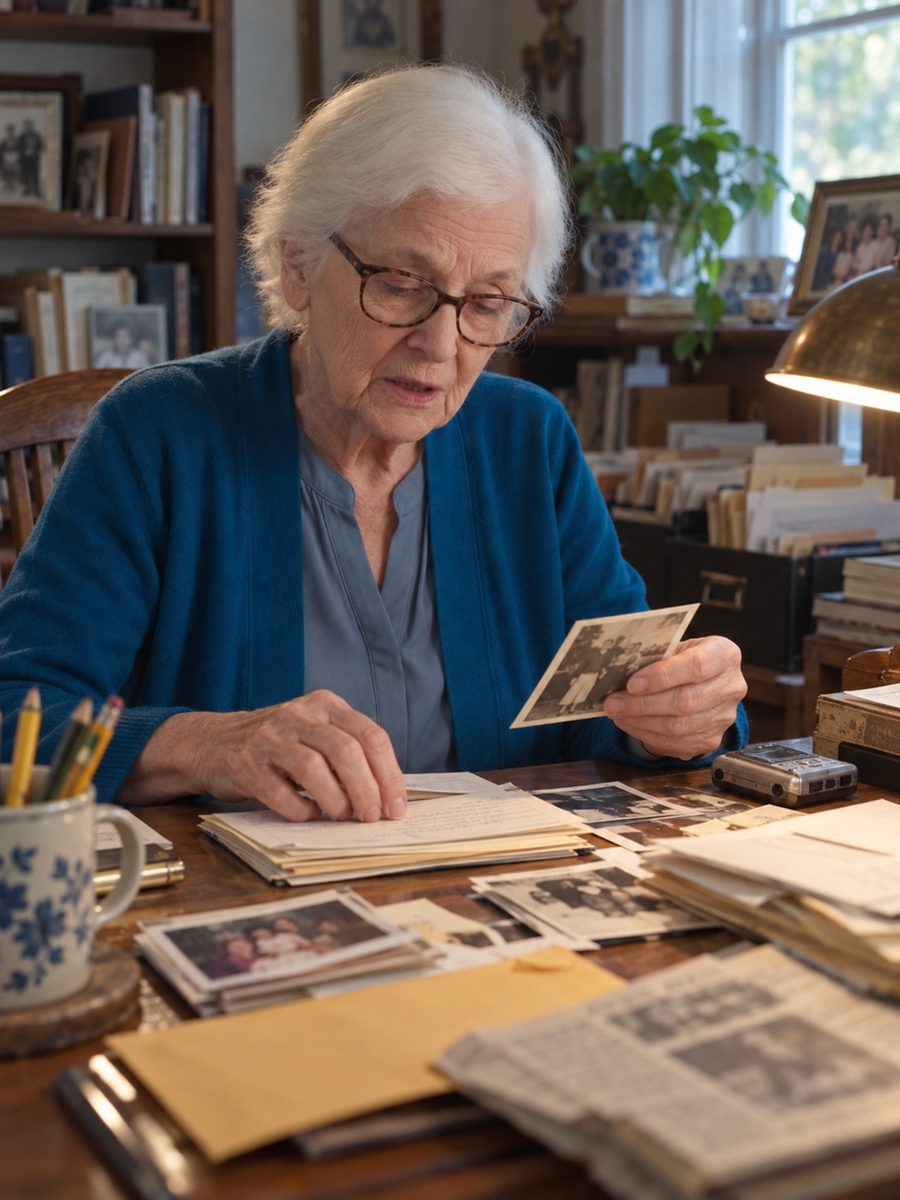
Mrs. Evelyn is 76 and lives in Maysville, Kentucky. She keeps a worn oak story desk where family photographs, clippings, envelopes and index cards wait to be identified before their stories get separated from their names.
She spent 36 years on the copy desk of a local newspaper, editing family notices: reconciling spellings, relationships, dates, hometowns and the everyday details that made a remembrance sound like a real person.
Her book is for anyone saving what is still knowable about a family, and for the adult children helping them do it.
PDF and EPUB editions to download, read or print. No subscription. No shipping.
193 pages · 11 chapters · 3 bonus books
Know Who Is in Your Old Family Photographs
You receive digital PDF files for Know Who Is in Your Old Family Photographs and the included bonus materials. Pay $29, then begin your instant download after payment.
$29$39Launch price — ends October 18
You can read the materials at your own pace and choose the methods that fit your photographs.
What you get for $29:
Individual values below are publisher estimates. Everything is included in your $29 purchase.
Know Who Is in Your Old Family Photographs
78 Methods for Examining, Handling, and Preserving Old Family Photographs
$39
Bonus book 1Name the People in the Picture
A large-print workbook for labeling names, relationships, dates, places, occasions, and the source of each identification. 37 pages.
Est. value$12Included
Bonus book 2Ten-Minute Voice Memories
A short-prompt mini-book for recording family memories in your own voice, one ten-minute session at a time. 29 pages.
Est. value$11Included
Bonus book 3The Family Names & Places Ledger
A practical family-reference ledger for names, nicknames, relationships, dates, places, spellings, and questions still to resolve. 31 pages.
Est. value$10Included
The printable field kit
69 printable pages: the worksheets and cards to use beside the book.
Included
Lifetime updates
Future revisions of this book at no extra charge.
$21
3 bonus books combined$33
Total estimated package value$93
You pay today$93$29
Secure one-time checkout. Your digital books are ready to download after confirmed payment.
Instant download · PDF + EPUB · print only the pages you need
Published by Mrs. Evelyn
30days
The Read-It-First Guarantee. Read the whole book and try it for 30 days. If it is not worth what you paid, ask for your money back through Whop, where you paid, and every dollar comes back, no questions asked. Whatever you have already downloaded, bonus books included, stays yours. You should not have to judge a book by its sales page.
07 · Questions
Questions worth answering
What exactly do I receive?
You receive digital PDF files for the book and the included bonus materials. The book has 193 pages and covers 78 methods for photo identification, family-story preservation, and careful handling.
Can I print it?
The materials are delivered as digital PDF files. You may use them as digital files or print pages that are useful for your own working notes.
Is it for me?
It is for readers who want practical ways to identify people, places, dates, and relationships in family photographs. It also suits adult children helping preserve what relatives can still tell them.
How do I start?
After payment, begin your instant download. Start with a photograph that has a clear clue, or begin with the first chapter and set up a clean work surface.
What if it does not help me?
Ask for your money back through Whop within 30 days and every dollar comes back, no questions asked. That is the Read-It-First Guarantee: read the book first, then decide.
Does this book tell me how to handle old originals?
Yes. It shows you how to document context before moving items and how to choose careful storage steps. It also explains when unidentified or deteriorated material should be left alone for separate care.
What are the included bonuses for?
They give you practical pages for labeling photographs, recording voice memories, and keeping a family names and places ledger. They are meant to support the notes you make while using the book.
Can I read it on a Kindle or e-reader?
Yes. The main book also comes as an EPUB file, which opens in Kindle (through Send to Kindle), Apple Books, Kobo and Google Play Books. The workbook and bonus books are PDFs, made to read on screen or print.
Put the names beside the photographs.
A name, a place, and a small true detail can keep a photograph connected to its people. Begin with what you can document today.
$29 once · 30-day Read-It-First Guarantee · instant digital download